
Highlights from the Resuscitation Council Scientific Symposium – Part 1
On the 6th November I attended the Resuscitation Council Scientific Symposium. There were many great talks. The one that struck home with me as a trainer was the presentation by Dr Richard Lyon.
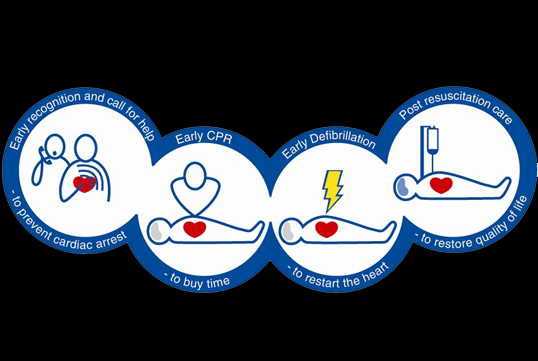
Richard talked about the Chain of Survival. I refer to this chain when I’m training and how every link needs to be strong. However, Richard suggested that we should be front loading the chain of survival. To highlight the importance of this he shared a story. There was a hush that went over the audience when we realised that the story he was sharing was about the death of his father, who died at his gym in 2002.
As an educator I was shocked to think that the staff involved, when Richard’s father died, had failed to identify that he had had a cardiac arrest and therefore hadn’t started CPR and that they didn’t have a defibrillator on site. On a practical level I’ve since checked with my gym that they do have a defibrillator on-site, does yours? I’d encourage you to check too.
The first link in the chain of survival is ‘early recognition and calling for help’. Therefore, any training should include warning signs that indicate someone is unwell and what particular warning signs to look out for. I’ve discussed more on this in my blog on the ABCDE approach.
I think one issue when identifying someone who has had a cardiac arrest is the high incidence of agonal breaths (approximately 40%). I demonstrate these for my learners and direct them to the lifesaver site. The demonstration of agonal breaths on this interactive video are very good, please take a look if you’re not sure. I also teach that if you’re not sure if they’ve had a cardiac arrest, it’s better to do CPR when it’s not needed than the reverse.
Many of my practices now have a defibrillator on-site, I’m pleased to say, and they are much more widely available. The evidence is showing that where defibrillators are available survival rates are around 40%, this is discussed in the recent Resuscitation Council report. Further to this there are often good news stories in the media, not least of which Simon Walker who was saved at his dentist.
It’s impossible to know if the outcome could have been different for Richard’s dad but going forward by improving education and the availability of defibrillators we can do our best for us, our loved ones and our patients.
In part 2 I will be focusing on end of life decision-making.
Would you like more information?
If you would like to discuss training or you would like advice on purchasing a defibrillator please contact me.
Very well presented document, interesting and clear.
Hi Chris, I’m glad you liked my blog, it was a great day with lots of very interesting presentations. Part 2 is to follow where I plan to talk about end of life decision making as the morning was devoted to this.
kind regards
Helen